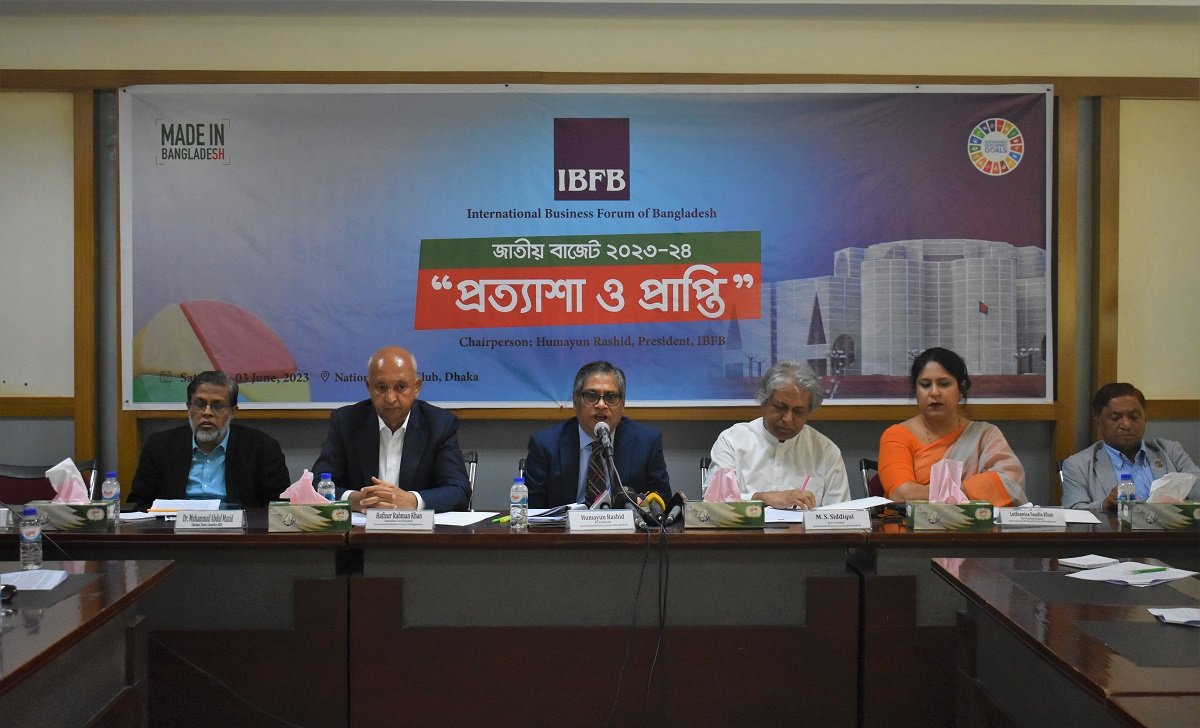
IBFB Press Conference on “প্রস্তাবিত জাতীয় বাজেট ২০২৩-২৪: প্রত্যাশা ও প্রাপ্তি”

Hon'ble Finance Minister of the People's Republic of Bangladesh Mr. AHM Muftafa Kamal, M.P. presented the supplementary budget for the 2022-23 budget year and the national budget proposal titled Smart Bangladesh's progress after a decade and a half of the development journey for the next fiscal year 2023-24 at the Bangladesh National Parliament on Thursday, 01 June 2023. IBFB salutes and thanks the Hon'ble Finance Minister for presenting the National Budget 2023-24 at the moment of facing various pressures and challenges including high inflation, rise in commodity prices, global crisis, dollar crisis, slowdown in business-investment and employment, National Parliament elections.
The International Business Forum of Bangladesh (IBFB), a research and advisory organization coordinating the introduction and linkage of the business and investment environment of Bangladesh in the international environment, believes that the recovery of the economy affected by the Corona epidemic, the impact of the Russia-Ukraine war, and the turmoil of the world economy by protecting the economy of Bangladesh. There is no alternative to a multifaceted, implementable and directional budget to promote sustainable development in developing countries.
In this context, a budget proposal of Rs 7 lakh 61 thousand 785 crore has been proposed for the financial year 2023-24 where the expected GDP growth rate is 7.5% and the inflation rate is 6.0% The main objective of this year's budget is to control inflation and maintain higher GDP growth, said Humayun Rashid, President of IBFB and Managing Director & CEO of Energypack Power Generation Ltd., at a press conference.
To achieve the goal of a developed Bangladesh by 2041, the Hon'ble Finance Minister has outlined the vision of 'Smart Bangladesh' based on (1) Smart Citizens (2) Smart Government (3) Smart Society and (4) Smart Economy.
International Business Forum of Bangladesh, being the champion of the dream of Smart Bangladesh, we are also firmly convinced and hopeful with the Honorable Finance Minister that in Smart Bangladesh, the per capita income will be at least 12 thousand 500 million dollars, less than 3 percent of people will be below the poverty line and extreme poverty will come down to zero; Inflation will be limited to 4-5 percent; Trade deficit will be 5 percent; The revenue-GDP ratio will be over 20 percent; Investment will be 40 percent of GDP... paperless, cashless society will be created.'' (Budget Speech, paras 8-9)
In the budget speech, there is a success story of the development journey of the past one and a half decades, there is a summary of the table of praise for foreigners, but because there is no explanation of the context of the challenges that are currently visible, the government seems to be helpless in dealing with the challenges and there is no roadmap to implement the strategy to deal with it.
Witnessing the success of the last decade and a half, the first budget was announced in the election year with the slogan of Smart Bangladesh's progress. The aspiration to stay in power has been revealed by avoiding responsibility for rescuing the economy plunged into various crises.
Ways to stop or reduce the huge government expenditure Occasional expenditure The huge amount of expenditure to start new mega projects shows that development without good governance must continue. There is no concern in the budget about the recent Moody's downgrading of global business investment, loans or grants.
Rather, it is supposed to pass the difficult time in comfort and self-satisfaction by showing it to another sector to make the traditional expenditure of one sector palatable. Blaming the effects of the Corona epidemic and the Ukraine-Russia war, in the context of the present times, 'to keep the almost stagnant economy running, to prevent unemployment and hunger, to control price inflation, to deal with the recession caused by Corona and the war, and to develop potential opportunities (in agriculture, health, IT, skilled manpower sectors). (more focus and efficient water resources generation) did not appear to be consistent with good behavior and coping with uncertainty. In the budget announced in the fiscal year 2022-23, the fear, conflict and situation of Corona and war were mentioned in the implementation of the budget, the distribution of income and expenditure was not reflected. The size of the budget, the allocation of the budget, the target set for tax collection have not been consistent.
Features of Budget: Positive and Negative Trends
IBFB feels that there is no other option but to encourage industrialization in the country to create employment and bring low-cost goods to the masses. We welcome the proposal to reduce customs duties on raw materials required by certain industries.
Health and education sectors were not taken seriously in the budget.
The social safety net has been somewhat widened.
The finance minister said that inflation will remain largely under control in the coming financial year and the annual average inflation is expected to stand at around 6 percent. He opined, “Inflation will continue due to reduction in fuel, food and fertilizer prices in the global market as well as adjustment of fuel prices in the domestic market and government initiatives to keep the food and supply system normal.
The proposed budget expands the spending target by 15.3% against global recessionary trends and this year's spending actually shrinks by 2.6%. Development expenditure for the next financial year is also targeted at 14.7% higher as against this year's revised expenditure which is only 0.7% higher than the original target.
The budget proposes a minimum tax of Rs 2,000 on individuals who file tax returns even if they have no taxable income but are obliged to file income tax returns for availing services from the government to promote this participation in government welfare. The minimum tax is expected to generate additional revenue of Rs 1,240 crore. The process of collecting minimum tax will create administrative complexity, fraud will increase. The objective will not succeed.
The budget contains a landmark announcement to introduce a universal pension scheme. The Universal Pension Management Act, 2023 has already been passed.
To increase the property registration tax in various areas including Dhaka, Chittagong, Narayanganj and Gazipur from the existing 4 percent to 8 percent in the fiscal year 2023-24, 8 percent of the deed value or Tk 20 lakh, whichever is higher, now 3 percent of the property under the jurisdiction of any district municipality. Taxation which is proposed to be raised to 6 percent.
The surcharge-free asset limit has been raised from Rs 3 crore to Rs 4 crore in the latest budget for 2023-24, though a minimum surcharge of 10% has been proposed, where an individual's total assets exceed Rs 4 crore and 35% surcharge for individuals whose assets exceed Rs 100 crore. In this case asset valuation should be based on the current market value of the asset. For example, if someone buys a house in Gulshan area 40 years ago, he pays tax on its market value at that time, which is not reasonable. They have to pay tax on an estimated present value. If the government evaluates the assets as per the current market conditions that will help in generating more revenue.
A road map is being formulated for establishing a permanent system of formula-based price adjustment in the energy sector. We hope to finalize the formula-based price adjustment mechanism by September this year. Total subsidies will gradually decrease in the medium term after the recent price hike and the implementation of the upcoming adjustment measures.
The amount, referred to as direct tax expenditure, is over 41 per cent from Rs 1,25,813 crore in 2020-2021, accounting for 3.56 per cent of GDP. At the same time, efforts are underway to explore alternatives to cash incentives to ensure that the growth of the export sector is not hampered.
Another new major is proposed for risk management. A separate allocation of Rs 4,000 crore has been proposed in case of risks to the economy in situations like the Covid-19 pandemic or the Russia-Ukraine war. A new step to deal with any adverse situation is the proposal for separate allocations in case of risks to the economy, such as the Covid-19 pandemic or the Russia-Ukraine war.
The government is providing policy support to exports by identifying the highest priority sectors, special development sectors and special development service sectors. However, in the post-LDC graduation period after 2026, measures such as rationalization of tariff structure and phasing out of cash support on export accounts will have to comply with the norms set by WTO norms, the budget said.
Bangladesh Bank has already reduced loans from reserves to exporters through the Export Development Fund (EDF). A $7 billion fund has been reduced to $5 billion. Besides, the interest rate on Uuri loans has been increased to discourage exporters from taking loans.
Besides, the Central Bank has formed a local currency fund called Export Facilitation Pre-Finance Fund (EFPF) of Tk 10,000 crore for exporters. Finally, there is a commitment from the FM to reform the tariff structure. The government is considering reforming the tariff structure and phasing out cash assistance for Bangladesh's sustainable graduation from least developed country (LDC) status.
Currently, the process of strengthening the manpower structure of the National Board of Revenue (NBR) is underway. A study is being conducted to help rationalize the scope, extent and nature of tax exemptions. NBR is preparing a 'Medium Term Revenue Collection Strategy (MTRS)' to help achieve revenue collection targets in the medium term. Income tax and customs laws are being modernized. The government is also trying to increase non-tax revenue. Updating of fees/rates, awareness and activation of Ministries/Departments to collect revenue from other sectors including identification of potential sources is in progress.
It is good news in the budget that, to reduce supply costs and strengthen financial stability in the power sector, the government will phase out the minimum capacity charge payment clause at the time of contract renewal for existing rental power plants or rental-operated power plants.
The government will aim to ensure sustainable debt management in the medium term. Hence, during the pre-transition and post-transition period, we will continue to seek sources of bilateral and multilateral foreign financing for credit facilities on the easiest possible terms. The Finance Minister has announced that the gap between the existing multiple exchange rates is being brought to a minimum with a view to gradually market-oriented exchange rates. Apart from this, the process of market-based interest rate and exchange rate is going on. Tariff rationalization, domestic resource mobilization to meet fiscal deficit, withdrawal of subsidy/cash assistance or exploration of alternatives etc. should now be considered.
The budget announced that tax exemptions and concessions, though rationally implemented, should be continued and existing tariff rates at the import level should be gradually reduced to meet the challenges of graduation from the category of least developed countries. Incentives to encourage capacity building of domestic industry need to be reduced accordingly. Proper identification and remedy of anti-export biases and gradual reduction of tariff rates will be a key factor for signing preferential trade agreements (PTAs) or free trade agreements (FTAs) with our important trading partners. These forward-looking steps will also help us address the post-graduation challenges. Hope the government fulfills the promise of reforms.
There is no good news for the fixed income group and there is almost no significant improvement in barriers to doing business in the budget. The budget mentions LDC graduation, but does not specifically mention any reforms except a promise to reform the tax structure.
IBFB's feedback, comments and recommendations on the overall review of the budget are as follows:
Finally, IBFB feels that the proposed budget should be regularly checked and reviewed on a quarterly basis to ensure that it is properly implemented. Parliament's authority and role in ensuring accountability can be made meaningful during the passage of the supplementary budget. A high-powered advisory committee involving the private sector may be constituted to review and monitor the implementation of the annual development programme. The said advisory committee will present to the government the guidelines for the proper implementation, review and scrutiny of the budget through the respective parliamentary committees of the national parliament.
The budget size of Bangladesh is increasing. As a result, the pressure to manage the budget and increase the implementation capacity is also increasing. We must improve the efficiency in budget allocation along with increasing the capacity of appropriate use of allocated funds. In this case, appropriate use of technology, proper monitoring of budget execution, coordinated communication between various ministries and increased consensus in reaching goals, increased ability to make quick decisions, learning from the experience of other countries and working together with development partners can help the country even in these difficult times. It is possible to move forward. Besides, we have no choice, now the burning issue is to control price inflation, deal with crisis of international food and fuel oil. The question of saving life is first, the second issue is livelihood. Needless to say, this is a new Bangladesh. The previous situation will not return. New situations, new problems, new possibilities. We still hope, avoiding the legacy of the past, the finance minister will take the initiative to implement accountability while passing the comprehensive budget and come forward to change the structure of the economy by restoring order in the financial sector.