Bangladeshi entrepreneurs should be allowed to invest abroad
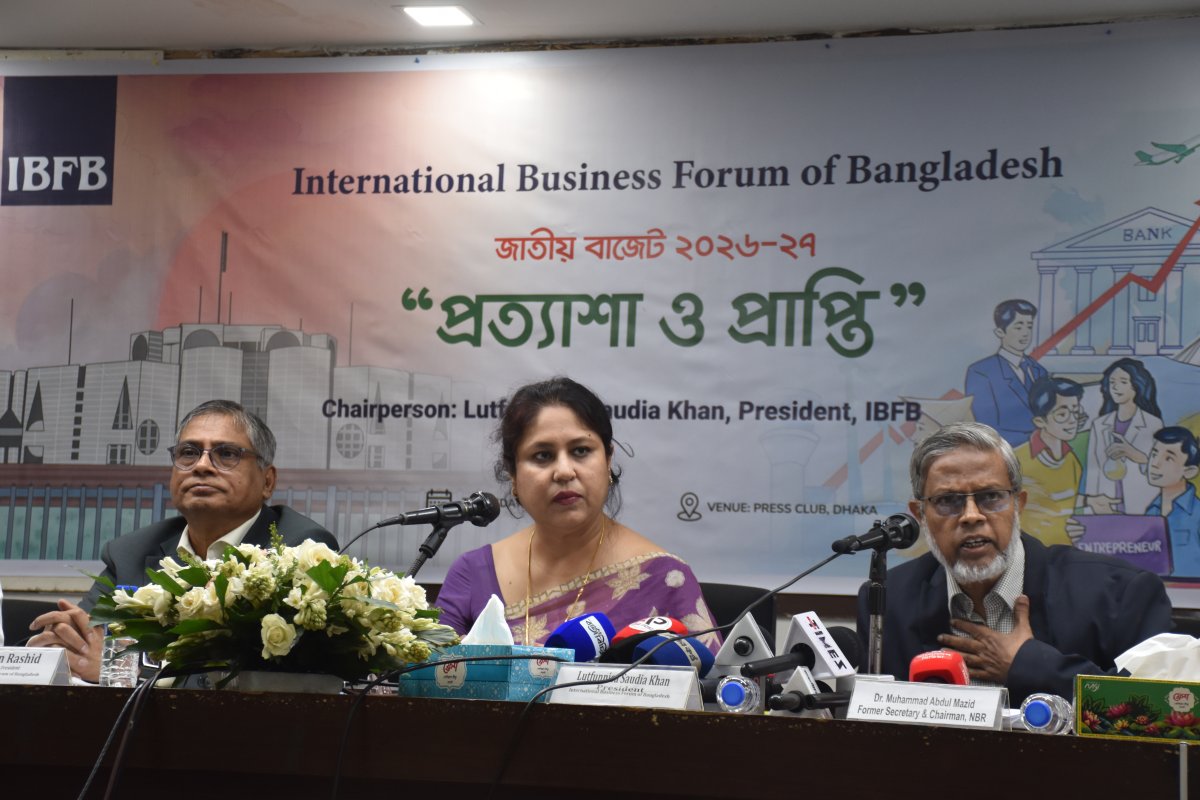
Mr. AK Azad, former FBCCI president, speaks at a view exchange meeting with Media organized by International Business Forum of Bangladesh (IBFB), at its Conference Hall at Tejgaon, Dhaka on 21st October 2015. Dr. Mohammed Farashuddin, former Governor of Bangladesh Bank was present as the Chief Guest. Mr. Hafizur Rahman Khan, President, Mr. Mahmudul Islam Chowdhury, Founding President of IBFB, Dr. Md. Abdul Mazid, Chairman of IBFB Finance Committee & former Chairman of NBR are also seen.
International Business Forum of Bangladesh (IBFB) organized a views exchange meeting with media on “Policy Guidelines for Overseas Investment by Bangladeshi Entrepreneurs” on Wednesday, 21 October 2015 at its Conference Hall at Tejgaon, Dhaka. Dr Mohammad Farashuddin, former Governor of Bangladesh Bank was present at the discussion as the Chief Guest, while Mr. AK Azad, former president of FBCCI was present as Special Guest.
The participants at the meeting strongly suggested that Bangladeshi entrepreneurs should be allowed to invest aboard, especially in countries having enormous investment opportunities such as neighboring India and Malaysia as well as in Africa, North America and western countries. They said the local investors have wide scopes to make overseas investment to undertake business activities in designing, manufacturing and marketing of goods and services as well as outsourcing products to avail of huge opportunities, because foreign markets in both developed and developing countries provide enormous growth opportunities.
For this, they urged the government to set a pragmatic policy framework incorporating the provision of making investment in foreign countries by protecting the interests of the country and facilitating the growth of the domestic market.
If Bangladesh fails to take advantage of opportunities in overseas investment, then it will limit the country’s GDP growth and poverty eradication. At the same time, this will encourage outflow of foreign currencies in unofficial channels, they viewed.
Expressing concern over a data that the illicit financial outflows was more than $12 billion during 2002 to 2012 and $1.8 billion in 2014, more than half the fund required for construction of Padma Bridge, they said, unauthorized transfer of such a huge amount was made due to absence of such a provision, causing big revenue loss to the National Board of Revenue.
Mr. Hafizur Rahman Khan, President of IBFB chaired the discussion. Mr. Dewan Hanif Mahmud, Editor and Publisher of The Daily Banik Barta, Mr. Sawkat Hossain Masum, Business Editor, The Prothom Alo,Mr. Golam Shahnee, Business Editor, The Daily Sun, Mr. Jamal Uddin, Business Editor, The Ittefaq, andMr. Masud Rumee, Business Editor, The Kaler Kantho were the panel discussants at the discussion.
A keynote paper titled “Policy Guidelines on Overseas Investment by Bangladeshi Entrepreneurs” was presented by Dr. Muhammad Ismail Hossain, Assistant Professor of the Department of Marketing of the Dhaka University.
Mr. Mahmudul Islam Chowdhury, Founder President of IBFB, Mr. Humayun Rashid, Vice President (Finance) of the IBFB, Mr. M.S. Siddiqui, Director of IBFB, Mr. Matiur Rahman, Director of IBFB and former President of Dhaka Chamber of Commerce and Industry, Dr. Mizanur Rahman, Member of IBFB & former Chairman of Bangladesh Tariff Commission, Mr. Main Uddin Chowdhury (Mayeen), Economist and Managing Director of Khan Bahadur Group also spoke at the meeting.
Addressing the program, Dr. Farasuddin said, “At first, we need to formulate a specific guideline by assessing some indicators. We have to assess the possibilities and prospects of investment where we wish to make, their profit and return of principal and also to make sure whether there is a level playing field”. Mentioning the necessity of overseas investment by Bangladeshi investors he said, “For FDI, the market should be framed by specific policy pinpointing who to invest and in which sectors”. He also urged the government to utilize foreign reserves in prospective fields, both at home and abroad. The government is offering many benefits for foreign investment in Bangladesh, but the number of investors making good use of the benefits is much lower than expectation, he said. “If we can remove the uncertainties and infrastructure constraints, foreigners will come,” said the former central bank governor.
Former FBCCI president Mr. AK Azad said that overseas investment is necessary for the development of the country’s private sector. “Foreign buyers always demand to invest in a third country to be a premier supplier. They do business with us in a certain limit as we are still gold supplier, he said. He also said, “We have talked to government bodies and Bangladesh Bank governor in this regard. We have been able to make the government understand why it is necessary to invest in other countries”. He said, businesses are not getting sufficient gas and electricity. “We did not see any major headway in introducing liquefied natural gas. We (factory owners) are in the dark about the future of energy supply”. Moreover, political uncertainty adds further woes at regular interval, he added. “Many countries offer cheap land and energy for foreign investments and we want to take the opportunity,” said Azad, the owner of a business group that exports apparel worth around $300 million a year. He also opined to create quota system of overseas investment at primary stage.
IBFB president said that it is the job of the IBFB to conduct research or initiate policy for sustainable development of the country’s manufacturing sector. “We are trying to open the opportunity of overseas investment by Bangladeshi investors. The government is also giving notice to this matter”, he said.
Daily Sun Business Editor Mr. Golam Shahnee said informal investment is being made in foreign countries. If this money were invested in formal way, then the country would have been economically benefited. He also said that it would be good if the amended provision of Foreign Exchange Regulation Act allows Bangladeshi entrepreneurs to manufacture and trade in foreign countries. He also suggests for advocacy in policy level.
In the keynote paper, it was focused that Bangladesh is still lagging behind in exploring the overseas investment opportunity. Though legally overseas investment was effectively restricted for the Foreign Exchange Regulation Act 1947, the government in September, 2015 amended the Act that provides “conditional provision” for opening up overseas investment from the current and capital accounts for export-oriented entrepreneurs only.
Speakers, however, suggested for making the investment scope for service sectors, especially in IT, banking and financial institutions, and other manufacturing fields. “According to Section 5(V), the opportunity of FDI outflow is strictly limited to the investors who are only in the export business and other potential investors are deprived of availing the said opportunity,” the keynote paper said. Mentioning that many firms from developing countries went abroad to the foreign shores since 1960s, it said the first overseas venture made by India was a textile mill set up in Ethiopia in 1956 by Birla Group of Companies.
Initially the entrepreneurs mostly invested in manufacturing sector mainly in lower value-added activities and later they heavily invested in the knowledge-based industry, especially in IT, one of the most value-added investment activities, it said.
Many countries like the USA, Canada, Australia, the UK, Japan, Germany, the Netherlands, Spain and Switzerland attempt to attract foreign investment by providing the right of residency, citizenship, investor visa. Some countries like Malaysia grant automatic residency to foreigners when they buy a property under the “second home program”, the paper mentioned.
Overseas investment can yield higher return, reduce transport costs by locating manufacturing plants within a consuming country rather than exporting from home country. This is especially important for bulk products such as motor vehicles, said Main Uddin Chowdhury (Mayeen). He, however, preferred the authority permits overseas investment in phases. This also allows investors gain access to cheap but skilled labor, skills including better management techniques and superior process technologies from its exposure to foreign markets. The experiences gained can be transferred to the home country resulting in a “reverse resource transfer effect”, said Mr. Humayun Rashid, adding, “This would help Bangladesh create its own brand”.
Firms that build factories in a foreign country within a trading bloc can avoid trade barriers such as tariffs and quotas, he added.
Outward investment can lead to increased income like profits from overseas subsidiaries and dividends, a portion of which will be send back to the country resulting in increase in remittance, the keynote paper mentioned.
The IBFB suggests that NBR should estimate the amount of revenue loss due to FDI outflow through illegal channel as well as to estimate the excess reserve held by Bangladesh. For this, it suggests for forming a “Foreign Direct Investment Cell” to deal with the proposals relating to outward FDI.
The cell can invite the interested local entrepreneurs, who are interested for making overseas investment, to submit project proposals relating to the venture. The prospective and potential investors shall submit proposals in prescribed form that might include fulfillment of certain requirements. After receiving the proposal, the cell can consider to go for a review process for allowing overseas investment, the recommendation included.