Advocacy workshops on Reducing Corruption in Accessing Industrial Credit
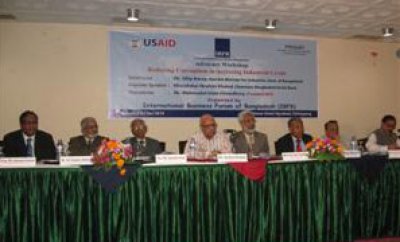
IBFB organized two national advocacy workshops titled “Reducing Corruption in Accessing Industrial Credit” held on 11 November 2010 and 02 Dec 2010 in Dhaka and Chittagong respectively.
Apart from the presentation of basic IBFB Research Paper on the topic,Mr. Khondokar Ibrahim Khaled, Chairman of Bangladesh Krishi Bank and former Deputy Governor of Bangladesh Bank presented the Keynote Paper in both workshops.
Prior to these workshops, a Stakeholders Meeting was held on 28 September 2010 in Dhaka where, among others, Dr. Mirza AB Azizul Islam, former Adviser for the Ministries of Finance and Planning, Caretaker Government of Bangladesh; Mr. Suhel Ahmed Chowdhury, former Commerce Secretary; Mr. Faruq A Siddiqi, former Chairman, Security & Exchange Commission (SEC); Mr. Safar Raj Hossain, Senior Program Adviser, USAID-PROGATI; Mr. Anis-ud-Dowla, President, Metropolitan Chamber of Commerce & Industries (MCCI); Mohammad Mijanur Rahman, Chairman, PHP Group; Mr. Zahiduzzaman Faruque,senior Journalist; Mr. Sajedur Seraj, Chairman, Aqua Paints; Mr. Iqbal Hossain, Director of IBFB attended the Stakeholders Meeting. Initial research findings on the aforesaid topic were discussed in this meeting, which were further modified upon valuable inputs and feedbacks received from cross section of relevant stakeholders, civil society members, academia, researchers, journalists, etc. present.
It was opined in both workshops that entrepreneur’s access to credit in a bank depends on availability of fund, bank’s expertise in using the fund profitably, bank’s skill in evaluating loan proposals professionally and bank’s capacity in identifying and scouting potential entrepreneurs from the open market. On the other hand, an entrepreneur should possess the skill to convince the bank regarding his or her ability and genuineness to have access to credit in a bank. Mr. Ibrahim Khaled, as he also mentioned in previous meetings, claimed some visible areas and carriers of corruption involved in the overall process of industrial credit in State-owned Commercial Banks (SCBs) e.g. (i) inadequate measures of encouragement and punishment, (ii) lack of professional need-based flexibility of operation, (iii) lack of personal stake and non-accountability of nominated directors of the Board, (iv) undue interference of governmental, political and other influential persons (v) corrupt trade union leaders under political patronization, and (vi) career advancement hazards for honest professionals. As to improve the scenario he suggested some basic points to be implemented immediately, such as revised compensation package for SCBs, Tadbir management, trade union reforms, etc.
Mr. Mahmudul Islam Chowdhury, President of IBFB, while presiding over the meetings held in Dhaka and Chittagong on the same topic, said that the economy of the country is still reliant to agriculture. But rapid and sustainable economic development and social advancement are essentially predetermined by industrialization. He mentioned that in 1980-81 FY the contribution of industrial sector to the GDP was 17.31% and this contribution increased up to 29.95% in 2009-10 FY. As such there is no other alternative than industrialization to increase GDP and thus enhance overall economic development of the country. In this context, he mentioned the Stated-owned Commercial Banks (SCBs) can play vital roles in transforming our Bangladesh to an industrialized country through establishing more and more industries. He also expressed that generally it is a very hard and money-and time-consuming task to obtain industrial credit. This is one reason for which people restrain themselves from industrial credit. Such attitude of the people should be altered through simplifying the process. Otherwise, industrialization will be deteriorated which in turn will negatively affect the economy.
Chittagong Workshop:
In the workshop held on 02 Dec 2010 at Hotel Agrabad, Chittagong, Mr. Noushad Ali Chowdhury,General Manager of Bangladesh Bank in Chittagong, stated that public banks consume time to take decision for industrial credit service. The political influence in getting bank loans has become a part of culture, which is difficult to get rid of fully. Mr. Sakhawat Hossain, Managing Director of Western Marine Services Ltd. claimed that the public service-holders are not providing their services properly and suggested three qualities such as standard of services, timely delivery of services and reduced communication gap will improve the services of SCBs. Professor Muhammad Sekandar Khan, President of BEA Chittagong Chapter mentioned political pressure in industrial credit processing as a part of corruption. Mr. A Q I Chowdhury, Vice Chairman of Chittagong Stock Exchange, emphasized on changing trade union policy to reduce corruption in SCBs. Mr. Ali Hossain Akbar Ali, Vice President of Chittagong Metropolitan Chamber of Commerce & Industries, on the other hand, pointed at infrastructural problems creating uncertainty such as inadequate supply of gas, electricity, etc. in business initiatives that involved a high level of investment input. He hoped that the government will be able to resolve this issues including corruption. Mr. Nasir Uddin Chowdhury, Vice President of BGMEA added that the regulatory obstacles for obtaining any necessary information or files from the banks should be eradicated. Political interference should also be curbed. This will automatically result in eliminating corruption.
Mr. Dilip Barua, Hon’ble Minister for Industries, while speaking as the Chief Guest, said that persons involved in corruption are quite powerful in this country and is a tough problem to resolve. To tackle the issue of corruption not only in the banking sector, but in a national scale, we need to act as unison against corruption. The public banks have some limitations as they cannot take decisions independently, which as a result incorporates inflation. The present government has taken steps to encourage the banking sector. At an initial stage, the public banks have been empowered to take decisions independently.
Dhaka Workshop:
The Advocacy Workshop on “Reducing Corruption in Accessing Industrial Credit” was held on 11 November 2010 at Hotel Sheraton, Dhaka.
While participating in the discussion session, Mr. Fazlul Azim, MP, pointed at unethical practices of some business persons who recently invested the sanctioned industrial credit into the capital market. He added that the capital market is turning into a gambling place while it is supposed to be a source of capital for industrial ventures. Pointing to undue influences in loan sanction process he said ‘bad credit leads to bad debts’. Mr. Abdul Majid, former Chairman of National Board of Revenue (NBR) mentioned that corruption induces more corruption, just like bad currency derives good currency out of the market. He felt that inclusion of a Chartered Account in the Board of Directors of SCBs may ensure greater transparency of the Accounts as such persons may have better insight on the overall balance sheet of the Bank. Mr. MA Siddiqui, Member of IBFB, opined that no bankers were sacked for their failure in loan proposal appraisal in the last three years. He emphasized on making SCBs more powerful, autonomous and independent, rather than keeping the controlling power in the hand of the government as political influence in industrial credit processing spreads up the existence of corruption. He also said that Bank officials should be able to assess the merit of industry loan or any other kind of loan being proposed and a strong committee should be established for proper evaluation and monitoring of SCBs. Ms. Lutfunnisa Saudia Khan, Director of Bangla Phone blamed the government for poor performance of SCBs. She mentioned that political influence for sanctioning a loan and banks sanctioning a loan without conducting any feasibility study on the process – both are very unfortunate.
Mr. A M A Muhith, MP, Hon’ble Finance Minister, while speaking as the Chief Guest in the Dhaka Workshop, stated that the political influence in getting bank loans has become a part of culture, which is difficult to get rid of fully. He praised IBFB for coming forward with some important recommendations for improving transparency of SCBs and agreed with immediate implementation of a few recommendations. The Finance Minister said implementing the suggestion of disqualifying a promotion of a banker and declining employee for contesting the CBA (Collective Bargaining Agent) elections are very much possible. “These particular suggestions can be implemented at once,” he added. He also endorsed the suggestion of setting a timeline for decision on a loan proposal and that a new pay scale for the banking sector will be approved possibly within the current fiscal year.
Both workshops were concluded with formal handing over of IBFB Recommendations for policy reforms to ensure easy access to industrial credit, reduce corruption involved in the process and improve transparency of the SCBs. The recommendations were as follows:
- Equity participation for industrial credit should be in the ratio of 70:30 (Bank: Borrower). Any circular issued earlier should be withdrawn immediately.
- Industrial Credit processing be made time bound from the existing practice requiring 70 days to be reduced to 30 days.
- Decentralization of power to expedite prompt sanction of Industrial Credit and sanctioning power up to certain limits should be delegated to field level executives, at least up to the General Manager.
- Board of Directors of State-own Commercial Banks (SCBs) should be appointed on merit and experience.
Any outside recommendation/pressure, written or verbal, should cancel a loan proposal.